Showing posts with label paco. Show all posts

Wednesday, 2 April 2008

Tandy TRS-80 Color Computer

Another Relic that cames directly from an Ebay auction (now with the "strong Euro" somethings are quite cheap to buy), this machine was produced in the Early 80 (from 1980 to 1983 by Radio Shark) and has a BASIC interpreter (like most of the home computers at this time), the processor was a Motorola MC6809E and was sold with 4Kb of RAM.


The machine cames with a colored basic manual as it was usual in the early 80 :

With nice illustration showing the fundamentals of BASIC programming, trying to attract young people to the language, and avoiding the "serious and technical documentation" of
the first PC sold.


The computer has connectors for TV, Tape Joystick and serial (for using a modem) or printer, and unfortunately a US connector for 120V electric power, I need to buy a 120V to 220V transformer to test it.


There is a lot of more information in the Wikipedia Page of TSR-80 Color computer that show more information about this machine.

Monday, 17 March 2008

Router Vine200

another machine that was literally going to the trash, I found it in a debris container in the street, a homeless was scavenging copper cables when I saw the four RJ-11 connectors, so I got
it, unfortunately without the power adapter that it seems that have a non-standard connector.

The router was covered with white stucco and after carefully removed most of them (still some in the photos) , I found the name of the vendor.


It seems that this router was used mainly by Jazztel an Spanish ISP, when installing xdsl connection in the professional lines, the ISP don't give the configuration password to the users, but as usual the credentials are easily found in Internet.

The four RJ11 connectors don't provide VoIP connections (at least no real VoIP), only allow to connect normal phones to the line.

Sinclair ZX80


The first computer manufactured by Clive Sinclair, the Sinclair ZX80 used (the zilog Z80 chip), the look of the machine is quite similar to the classic ZX81, but as the pictures shows this is still thinner than the ZX81.

The machines included the BASIC interpreter (with the "clasic" token keys , and has connectors for an external tape drive.

It's quite difficult to find this machines in Europe now, most of the current sellers are from the United States, and sometimes the auction price is more than 400$. This was cheaper but only because there is no power supply (I think that the ZX81 has the same kind of connector).


Sunday, 11 November 2007

Console Intellivision

In the beginning of the 198x, there was some consoles that perhaps weren't as popular as the newest ones., but some of them were quite amazing when you think about them now.

One of them was intellicovision, they use a ROM cartridge that must be plugged in the console to play the games.

The hand-held controllers have not only the "joystick" (round button), but also 12 digits, and other buttons in the sides of the controllers , depending of the game those buttons are used for different purposes.


The games, ....

There were different games, from the typical shot-up (space invaders, space hawk, ...) to some sport games, like soccer or tennis .

This console was donated by Jesus Guillamon, a friend from Murcia, and still works :


The screen seems to be quite snowy , perhaps the video chipset has been damaged after so much time, but still it's possible to play the games.

Sinclair Spectrum +3

Amstrad bought Sinclair Research in 1985, and after that they produced some Spectrum with tape and floppy disk included.

The last one was the Sinclair Spectrum +3 , that had a 3'' floppy disk.


Below there is a detail of the floppy disk unit:


This unit was buy in Ebay from UK, so it have the UK power jack, but works fine in Europe.

The system tries to boot flom the floppy disk before showing the menu, this would allow this spectrum to boot other operating systems (it seems that there was a CPM disk for the Spectrum ;-), before booting from the rom.

Tuesday, 7 August 2007

Commodore Amiga 500

f
This is another historical computer , a commodore Amiga 500, this was the FIRST commodore with a 32 bit CPU , with a compact style (keyboard, disk drive (800Mb) and CPU in the same box). as it was usual in the MicroComputer.

This wasn't the FIRST 68000 Micro Computer, Sinclair for example launched the QL (Quantum Lap) before, but this was the first successful one.

This computer was very advanced for its time, it has a 3.5 floppy drive instead of tape, and internally it has a dedicated graphic processor and another coprocessor for the sound.

A lot of people organized championship (demo scene) to program special effects with this machine, the operating system (graphical interface ) was another big point.

The machine is a gift from my friends of "Harry el aleman", one of the best places in Madrid to drink German beer

Friday, 6 July 2007

DEC 4000/600

This machine was part of RedIRIS , the Spanish Academic and Research Network and was used in the late 198x, and first 199x.


The box in the left is the Main CPU, at the RIGHT there is hard disk cabinet.

The machine has 64Mb, of memory and was used mainly to provide Internet/OSI related services to the Spanish Research Community.

The machine was used, for example, to keep the X500 directory (LDAP is based in this protocol), and also to provide email (not only SMPT/TCP services, also X.400 ).

Also it's very likely that the first DNS server for the ".es" Top level domain were running
in this machine.


Opening the door we can see that there are three hard disks (one seems to be broken),
ethernet (RJ-45/BNC) connection, console connection (with the typical DEC connector) and some serial card for consoles and serial connexions to other hosts.

Monday, 11 June 2007

Casio FX-850

This is an small calculator, with a BASIC interpreter and RAM memory (32/64k), it was made by the well known Japanish Calculator firm CASIO. A relative that was working in Canary Island, when the electronic products were still cheaper than in Spain bought one it for me in 1988, but unfortunelly the calculator fell from a second floor in 1992, and the display was broken.


The calculator has also a memory bank with more than 100 different mathematical functions and programs.

This model was buy in ebay in March 2007, in Thailand, good shipping from there , and was partially functional, I'm still looking for one of the memories to be able to access to the memory.

Thursday, 10 May 2007

Apple II : lying in the trash

Sometimes strange things happens , Yesterday I was in the terrace of a Bar drinking a beer with some friends, when a bum started to dig in the trash of a container near our table, he found some computer element and started to try to break a solid square box to remove some cables, after some attempts he leave the container.

After a few minutes I went to the container and what was lying there ? .... a very old Apple II Europlus system, with two 5 1/4 floppy drive !!!

Below is the photograph of the machine after arriving home and cleaning some of the dust

It seems that some keys are missing but my first impression is that the motherboard and floppy controler would work, I will loook for some TV cables to connect the system to the TV and see if nice machine still works.

Unfortunately the floppy cables has been removed, so I will try to build a new ones for the floppies.

About the apple II , this was the second machine build by apple, this machine have a 8 bit processor , and apple start to sell this model several years before the first Mac.

Sunday, 4 March 2007

DEC 3000/400


This old 64 bit system (according to Wikipedia , this models were build from 1992 to 1995), has been donated by a Spanish University.

This machines were the FIRST with a 64 bit processor (Alpha), from DIGITAL, later buy by compaq , now part of HP, nice world, Digital is one of the historic companies. and Unix was first develoved in a "PDP" series machine.


the system is currenly runninng an old operating system named OSF/1:,

# uname -a
OSF1 theory.cie.uma.es V4.0 878 alpha


but in the ALPHA chip, you could also run OpenVMS (from Digital), most of the free Unix (*BSD, Linux) and also Windows NT for Alpha !!!

This machine has the following hardware configuration:

DEC 3000 - M400

Digital Equipment Corporation
System conducting power up tests
------------------------------------------------------------

Devnam Devstat

-------- -------
CPU OK KN15-BA -V7.0-S887-I21F-sV1.0-DECchip 21064 P3.0

OSC 133 MHz
ASIC OK
MEM OK 64MB
NVR OK
SCC ?? 004 0060 ptr(0) = Not Present keybd(2) = Not Present
NI OK Ethernet Address: 08-00-2B-3F-8F-1A , TENBT

SCSI OK
ISDN OK
TC0 TC0 OK - PMAGB-BA
------------------------------------------------------------


Interesting is that the machine can be opened very quickly: here is an image of the interior , see the FAN row , they don't produce any noise when running.


unscrewing two screws, the rest of the hardware is opened:


showing the memory banks and CPU and the three fan in a row.


As usual with the Digital system, the console uses a "non standard" connector, named "MMJ", and need also a "MMJ to RJ45" cable named BN24J-07 , with and aditional adaptor from RJ45 to DB9 to be used for console, here you can see the rear part of the machine, with the ethernet connector (RJ45 and AUI), the ISDN and RJ11 (modem) connector and then the MMJ , Serial , Parallel and SCSI connector.


To be able to change the root password the system must boot on single user mode, remount the root partition with read write permissions and then change the /etc/password file , deleting the root password "root::0:1:root users:/:/bin/sh:

  • from the boot prompt boot: >>> boot -fl s
  • from the # console mount with rw persmissions: mount -u /
  • Set the console to VT102 : TERM=vt102
  • export TERM
  • launch vi : vi /etc/passwd
  • Contiene with the booting: exit

This is a new addition to the Museum.


Tuesday, 21 November 2006

Sun Ultra1


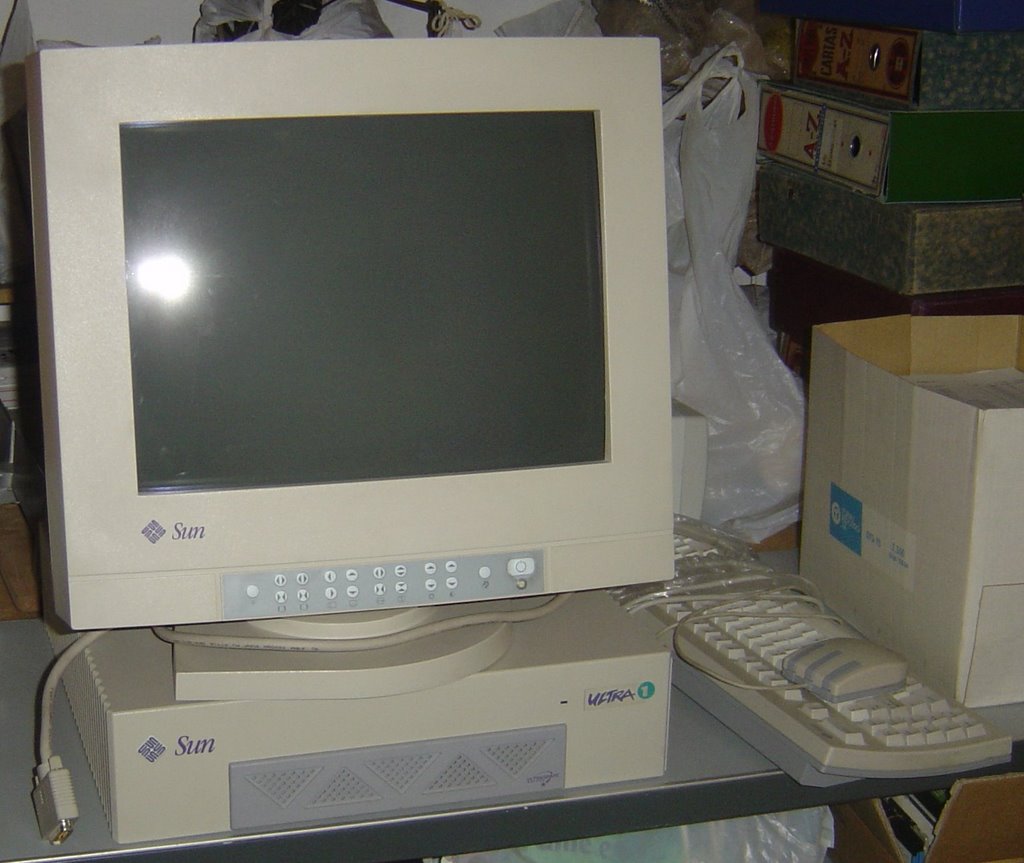
This computer was adquired about 1995 , and ceased to work about 2004 , it was one of the first machines with a 64 bit sparc CPU . The machine have only 64Mb of RAM , not so much now but enought for a small server (HTTP, SMPT/pop3, FTP) that can also used as personal workstation.

The machine has two internal hard disks and a cdrom , and was updated with an external/low cost SCSI disk to accomodate the "/home" of the users.

The mouse was an optical one, typical of Sun, but not usual for normal Pc users, and the mouse pad was required in order to work with it.

The operating system was solaris 7, unfortunately the system disk is broken so we are waiting for some folk to provide us with a new one .

HP9000 model 850


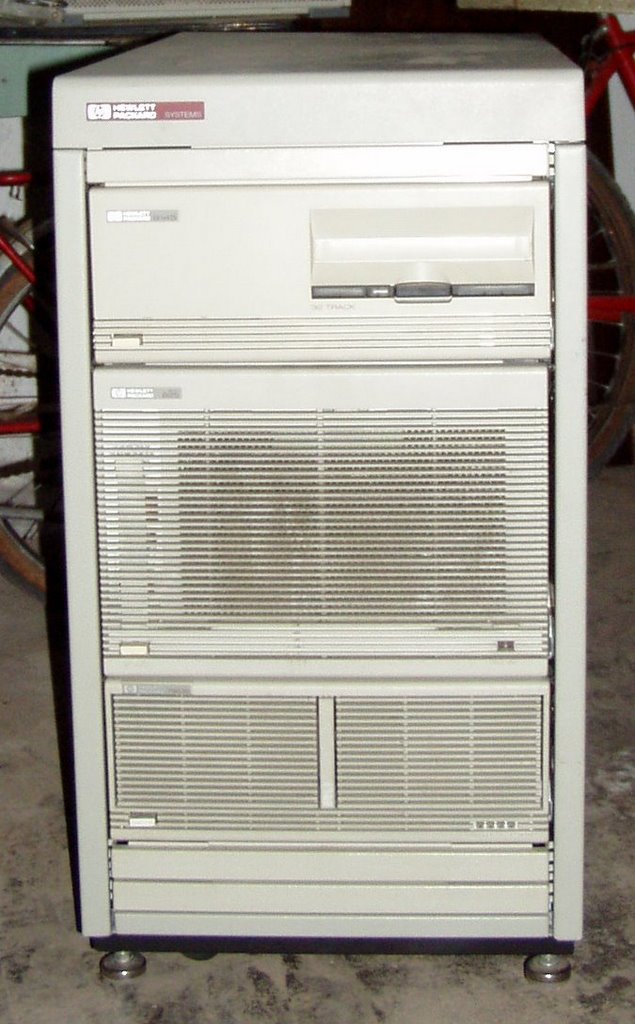
This is a old machine (it's still running a old HP-UX 6.X operating system) that was used for a long time as laboraty system for C programming and also as central mail server for the computer department.

The machine was shutdown in 1999, after detecting that the operating system was not Y2K compatible, and there were no patch for it ;-), the operating system was from 1988, so it was a long time running.

The operating system lacks of all the Gnu commodities and modern system commodities (no bash, no color ls , user password in the /etc/password file, etc), etc and obsviusly few "normal" init daemons, and was configured to use TCP/IP and X.25 network.

The system is still capable of running (it's currenlty shutdown due to the energy problems in the room ;-), and after changing the password (nice password recovery help in google) I was able to setup a network and connect using telnet to the system.

The first module in the top is the tape unit (sorry , We don't have any tape to test) , the second is the CPU itself and the last one is the Hard disk unit, a lot of noise but they still boot, also we have the monocrome orange terminal that was used for connection to the system.

We are looking for a "modern" HP-UX (at least Y2K compatible) that could be installed in the system, and if possible a spare hard disk to not delete the original HP-UX 6.X operating system (it's a relic by itself ;-).