Showing posts with label 198x. Show all posts

Monday, 2 May 2022

Juego de Tenis , fronton y ....


Esta entrada es un poco más larga , han sido algunas horas rebuscando información por Internet sobre un curioso juego de tenis que hizo mi hermana en base a un Kit de electrónica, antes de la llegada del ordenador personal.

A principios de los años 80 existían los llamados Kits de Electrónica , donde con un paciencia, un soldador y el Kit correspondiente se podían construir bastantes montajes electrónicos.  Uno de los montajes que hizo mi hermana fue un juego para la TV , que permitía a dos jugadores jugar a los juegos de Tenis, fronton y futbol. 

En la siguiente captura se puede ver los mandos del equipamiento y el juego de futbo con dos jugadores en una televisión de tubo, los mandos como no eran analógicos y el juego aunque antiguo todavía es bastante jugable.

Investigando un poco , y rebuscando entre los papeles perdidos encontré un catálogo  de la marca VaKit en el que aparece indicado como número 108 este juego, por desgracia no encontré la caja con la instrucciones de montaje.
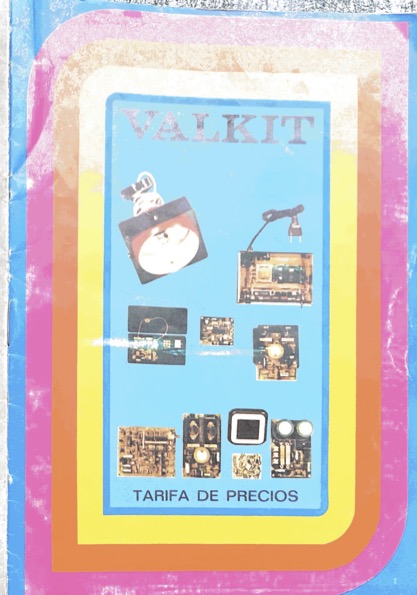


Sin embargo  me puse a rebuscar de nuevo en las enciclopedias de electrónica , que también tenían mucho éxito por esta época y en la enciclopedia práctica de electrónica en su número 22 (que costaba 100 pesetas del año 1982), aparece un montaje muy similar.


Que después de examinar es efectivamente la descripción del montaje del Kit-108 de Valkit  con toda la información.

Con una mentalidad "clásica" del informática == ordenador , me pongo y a buscar en la descripción de los componentes, etc, a ver si puedo averiguar el tipo de memoria, procesador, etc y resulta que en todo el montaje solo hay 3 "circuitos impresos" , (IC1 a IC3), y examinado la descripción y buscando por internet como no aparece que el Chip MM57105N  de National Semiconductor, puesto a la venta en 1976 , es el chip en que esta este "pong en un chip". En esta página se describe como en los años 70 hubo varias compañías que desarrollaron este tipo de juegos en un chip,  rebuscando un poco más el MM57105N es la versión PAL (europa) del MM57100N (NTSC) del cual todavía se puede encontrar el datasheet  con información del chip.

Esta visto que los SystemOnChip, SoC, no son invento reciente  ;-)

Postdata: Como desilusión resulta que los juegos no eran tenis, fronton y futbol, sino tenis, fronton y hocket, esta visto que nos creíamos cualquier cosa.


Sunday, 4 March 2012

Apple II & Unitron Clone


The computer that launches Apple to the fame was the famous now  apple II,  I'm not going to start here talking about this computer or company , mostly because there are a lot places in internet where you can find information about the model.

Those computers wheren't so frequents in the South of Spain because there were too expensive compared with the Sinclair/Amstrad and similar computers that most of the young people started in computers.

I was lucky to receive two computes when I started to collect old computers, full with floppy drive unit, extension cards (including a serial card and modem) and a lot of programs, I will try to boot again both computers soon, but first I need to find a old TV to connect the machines.

Both computers seems to work, at least the keyboard light works when both computers powers on , but I still need to test them again.

One of the curious thing is that one of the computers is not named "Apple", but it is branded "unitron",  but as you can see from the pictures both of them are equal, and in fact the floppy drives, extension card and so on are compatible.

Looking at http://www.museo8bits.com/unitronap.htm it seems that the unitron where clones made in Brazil, so it's interesting how the computers come to Spain.


Monday, 13 December 2010

Macintosh Portable

In the last year of the 8x, Apple had a good customer base, and they have successfully moved from the Apple II series to the original Mac, so it  was time to  think in the executive people that were moving from some place to other, so they launched their first "Portable" computer.


This "ancestor" of the Ipad weight about 7Kg, so it was not  usual to see people using it in the airports to read their  emails ;-) (FaceBook was not invented so people don't use this computer to updade their profile ;-)


Internally this Mac has a lead-acid battery , that unfortunately in this model is not woking...


But we are looking for a replacement, it would be nice to see which documents and presentations has this Mac inside ;-)

Friday, 8 May 2009

16Kb memory expansion for ZX81


The original sinclair ZX81 has only a 1kb memory of RAM, so it was quite difficult , but not impossible , to produce any big program, obviously soon there was memory expansion for them and one of those modules was the 16Kb memory extension (usually any image of this blog , compressed and so on it's too big to fit in those memory modules, but in a few years ago 16 kytes of RAM where a lot of space .


As a curiosity , the three first models of sinclair used the same processor, the zilog z80, so where able to access up to 64Kb of RAM (2^16) , so with the different size in their ROM size (BASIC interpreter, Input/Output routines, etc), produces that the total RAM size of the machines where bigger in the first models (up to 60Kb in the sinclair ZX80, 56 kb in the sinclair ZX81 and only 48Kb in the last model sinclair Spectrum.

After the sinclair spectrum the other models (sinclair spectrum 128, +2, and +3 ) used a technique named "pagination" to share a memory space between different memory banks allowing to have more than 64kb, but not at the same time.


casio FX-702P

Another calculator from casio, with a BASIC interpreter allowing to develop your own programs, this model has the unusual feature of not using a QWERTY keyboard, and keys are aligned following their alphabetic order in a 7x4 rows


Sinclair ZX-interface 2


Sinclair made some interfaces to enhance the posibilites of the most successful product, the Sinclair Spectrum , those interfaces include the interface 1 (allow to connect to microdrive units and serial RS-232 interface ) , the ZX-printer interface (thermal printer and this interface, named "interface 2".

This interface allow to connect two joystick to the spectrum , using the "Sinclair type joystick", that usually links the numeric keys to the joystick and the other facility provided by this interface was the use of memory cards with games and utilities that allow to start running applications and programs without loading them from tape.


Unfortunately the cartridges were quite expensive so few games were produced in this format, also it was ROM (read only memory) so people can't save their own games in them.


Tuesday, 27 January 2009

Quantum Lap , Sinclair QL


In 1984 sinclair launched the QL, Quantum Lap, as a computer aimed to a more professional sector, it has some revolutionary aspects (it was based in the 68008 Processor, a 32 bit processor with a 8 bit interface, ( 8 bit connectors and hardware was cheaper and price was always one of the basic features of Sinclair machines).


The system has a revolutionary "multi tasking BASIC interpreter", 128 Kb of RAM and instead of using the expensive floppy drives (remember 1984 , 5' 1/4 floppy were still common in 1990, or the slow and sequential tape system (like the spectrum ), uses their own technology , the "microdrive"

Microdrives were in fact small tapes that were inserted in the unit and must be formatted to be ready, to use, allowing to store about 85kb of data.

As the tape runs quite fast, the tape must be formatted in sectors , so it can be used as a random
device (instead of the typical sequential tapes).

Here is the a view o the unit, the QL came with two units

As this machine was targeted to the profesional market it come with a full "Office Software", in four
microdrives and other blank microdrives.


The package was "Quill" (the word processor), Abacus (spreadsheet ) , Archive (Data Base) and Easel (Graphs) that provides most of the usual needs for an normal user.


The machine provides two serial interfaces and was able to connect to other QL machines using their own network protocol (similar to token ring), and be connected to a normal TV or a computer monitor, also has serial interfaces ,


The three first sinclair


The first years of the 1980 decade was dominated in Europe by sinclair, the company launch a new model of computer every year, changing from the "white" ZX80 , with 1 Kb of RAM, then the ZX81, with provided a better BASIC support , but still only a 1K of RAM , and the next year the Spectrum with
Color !! , and 16Kb of RAM (or 48K in the upper model) .


Sinclair Spectum 48K aka gomas

This is the FIRST model of computer that I got, as I told before I "upgraded" the sinclair 48k to Sinclair + (the one two or three post before).

This machine is a gift from a college  after he discovered my not so hidden Computer Diogene Syndrome (recollect all kind of old computers ;-)

About this machine there is few more things to say perhaps that the best Spanish Company started developing games for this platform (Dinamic ) and that more than a generation of Computer Engineers and technical people in Spain grew and learn to play games (and sometimes also some BASIC language ) with it.
The machine was too popular that some radio station used to broadcasts games that the user save in a normal tape , loading the games from the tape.
here you can see, from left to right the power connector, expansion slot and the plug for saving and loading files from a normal tape.

Monday, 12 January 2009

Philips P3105

This was the third computer that I got , after the beloved Sinclair Spectrum and a CASIO FX-750 calculator with a BASIC interpreter. It was bought in Summer of 1989 , and it was a big jump , compared with the old spectrum , not only in size, but also in the use of disk and the hard disk
(20 Mbytes).

The CPU was an intel 8088 , that can run at the "normal" (4.x Mz) and "fast" (8.xMz,) speed , and has a program to change the the speed internally , the 3.5 drive (720 Kb) where added the same
year, and it was an "high density" drive, but the floppy controller only support the double density
(720kb).

The monitor was monocrome (orange one), with a mixed CGA/Hercules card and an amazing memory of 768 Kb, (640Kb of normal RAM used by MS-DOS and another 128Kb that only with MS-DOS 5.0 and the special software "Qemm" where possible to use for driver.

The Operating System was old MS-DOS 3.30 ,and also in the following years I upgraded the machine to other Operating Systems up to MS-DOS 6.2 , installed the "stacker driver", (to duplicate the hard disk space), and played a lot with it.

I remember also to play with the minix 1.x operating systems (booting from the 360Kb disk drive) and also booting the MS DOS 1.1 , that don't provide the "subdirectory feature (it was mostly a clone of the CPM operating system, other software that runs in this machine was the microsoft windows (from 1.x to 3.11), the GEM Desktop (digital research clone of MacOS graphical environment) and so on.


Sinclair Spectrum 48k

This was the first computer that I got, in 1984, the current keyboard is newer , as it was purchased as a normal sinclair and late converter to the "plus" one (the only difference was the keyboard).


The machine has a zilog z80 microprocessor and has 16kb of ROM and a RAM memory of 48Ks, including 6912 bytes for the graphics display and other system variables so only about 40,5 kb where employed normally for games and software.

The programs where loaded from a tape (I still have too much tapes full of programs ;-), and it was possible to program in BASIC and machine code, the graphic resolution was not great , but some of the programs are still amazing .

In order to save RAM space the BASIC interpreter assingned one of the ASCII code to each of the language keyworks, so for example the "print" command employs only a a byte of memory. A complicated combinations of keystrokes allow to produce all the symbols, one of the various emulator was named "JPP" , due to the fact the "J" key directly puts the "load" command and the double quotes wre in the "P" key so JPP was roughtly load "" , the order to load any program form the tape.

In this picture you can see the power plug for the external power adaptor , the expansion slot and the tape plugs for connecting the machine to and external tape. Later sinclair models (+2) have the
tape incorporated to the machine.

I'll try to find all the hardware (for example a game save device, parallel port, etc) that I 'd for this machines

The most usual problem with this macine was the keyboard, under the plastic cover in the Spectrum 16k and 48k, there were this plastic membrane that was easily broken when you tried to play games, and the only solution was to replace it.

Wednesday, 8 October 2008

Sinclair PC200

This was the last machine produced by Sinclair after the company was bought by Amstrad , and in fact the "sinclair name" is only a commercial brand as it seems that the model is not derived from the work of Sinclair Research, but directly from Amstrad.

This is also the only "PC" clonic from sinclair, and it was intruduced in the late 80's, when the amstrad.

The computer is similar to the Olivetty PC1, and other PC clonic in the sense that has the keyboard and CPU integrated in the same chasis, it has a 8086 compatible micro and a 720Kb 3 1/2 disk drive.


As curiosity the computer has output for a CGA monitor and also a TV monitor, in this other picture you can see the TV , CGA , Serial and parallel connectors, and also the
expansion bay.


After some problems (it's very difficult to find a CGA monitor to test the computer) , I realized that I have some "TV" connectors from other very old computers like the sinclair spectrum so I tested and ....


Keyboard is not working ;-(, it seems that the computer has some keyboard problem, it's a pity as it seems that only 20.000 units of this computer were sold, so it is very difficult to find a working one.

Wednesday, 2 April 2008

Tandy TRS-80 Color Computer

Another Relic that cames directly from an Ebay auction (now with the "strong Euro" somethings are quite cheap to buy), this machine was produced in the Early 80 (from 1980 to 1983 by Radio Shark) and has a BASIC interpreter (like most of the home computers at this time), the processor was a Motorola MC6809E and was sold with 4Kb of RAM.


The machine cames with a colored basic manual as it was usual in the early 80 :

With nice illustration showing the fundamentals of BASIC programming, trying to attract young people to the language, and avoiding the "serious and technical documentation" of
the first PC sold.


The computer has connectors for TV, Tape Joystick and serial (for using a modem) or printer, and unfortunately a US connector for 120V electric power, I need to buy a 120V to 220V transformer to test it.


There is a lot of more information in the Wikipedia Page of TSR-80 Color computer that show more information about this machine.

Monday, 17 March 2008

Sinclair ZX80


The first computer manufactured by Clive Sinclair, the Sinclair ZX80 used (the zilog Z80 chip), the look of the machine is quite similar to the classic ZX81, but as the pictures shows this is still thinner than the ZX81.

The machines included the BASIC interpreter (with the "clasic" token keys , and has connectors for an external tape drive.

It's quite difficult to find this machines in Europe now, most of the current sellers are from the United States, and sometimes the auction price is more than 400$. This was cheaper but only because there is no power supply (I think that the ZX81 has the same kind of connector).


Sunday, 11 November 2007

Console Intellivision

In the beginning of the 198x, there was some consoles that perhaps weren't as popular as the newest ones., but some of them were quite amazing when you think about them now.

One of them was intellicovision, they use a ROM cartridge that must be plugged in the console to play the games.

The hand-held controllers have not only the "joystick" (round button), but also 12 digits, and other buttons in the sides of the controllers , depending of the game those buttons are used for different purposes.


The games, ....

There were different games, from the typical shot-up (space invaders, space hawk, ...) to some sport games, like soccer or tennis .

This console was donated by Jesus Guillamon, a friend from Murcia, and still works :


The screen seems to be quite snowy , perhaps the video chipset has been damaged after so much time, but still it's possible to play the games.

Sinclair Spectrum +3

Amstrad bought Sinclair Research in 1985, and after that they produced some Spectrum with tape and floppy disk included.

The last one was the Sinclair Spectrum +3 , that had a 3'' floppy disk.


Below there is a detail of the floppy disk unit:


This unit was buy in Ebay from UK, so it have the UK power jack, but works fine in Europe.

The system tries to boot flom the floppy disk before showing the menu, this would allow this spectrum to boot other operating systems (it seems that there was a CPM disk for the Spectrum ;-), before booting from the rom.

Tuesday, 7 August 2007

Commodore Amiga 500

f
This is another historical computer , a commodore Amiga 500, this was the FIRST commodore with a 32 bit CPU , with a compact style (keyboard, disk drive (800Mb) and CPU in the same box). as it was usual in the MicroComputer.

This wasn't the FIRST 68000 Micro Computer, Sinclair for example launched the QL (Quantum Lap) before, but this was the first successful one.

This computer was very advanced for its time, it has a 3.5 floppy drive instead of tape, and internally it has a dedicated graphic processor and another coprocessor for the sound.

A lot of people organized championship (demo scene) to program special effects with this machine, the operating system (graphical interface ) was another big point.

The machine is a gift from my friends of "Harry el aleman", one of the best places in Madrid to drink German beer

Friday, 6 July 2007

DEC 4000/600

This machine was part of RedIRIS , the Spanish Academic and Research Network and was used in the late 198x, and first 199x.


The box in the left is the Main CPU, at the RIGHT there is hard disk cabinet.

The machine has 64Mb, of memory and was used mainly to provide Internet/OSI related services to the Spanish Research Community.

The machine was used, for example, to keep the X500 directory (LDAP is based in this protocol), and also to provide email (not only SMPT/TCP services, also X.400 ).

Also it's very likely that the first DNS server for the ".es" Top level domain were running
in this machine.


Opening the door we can see that there are three hard disks (one seems to be broken),
ethernet (RJ-45/BNC) connection, console connection (with the typical DEC connector) and some serial card for consoles and serial connexions to other hosts.

Monday, 11 June 2007

Casio FX-850

This is an small calculator, with a BASIC interpreter and RAM memory (32/64k), it was made by the well known Japanish Calculator firm CASIO. A relative that was working in Canary Island, when the electronic products were still cheaper than in Spain bought one it for me in 1988, but unfortunelly the calculator fell from a second floor in 1992, and the display was broken.


The calculator has also a memory bank with more than 100 different mathematical functions and programs.

This model was buy in ebay in March 2007, in Thailand, good shipping from there , and was partially functional, I'm still looking for one of the memories to be able to access to the memory.

Thursday, 10 May 2007

Apple II : lying in the trash

Sometimes strange things happens , Yesterday I was in the terrace of a Bar drinking a beer with some friends, when a bum started to dig in the trash of a container near our table, he found some computer element and started to try to break a solid square box to remove some cables, after some attempts he leave the container.

After a few minutes I went to the container and what was lying there ? .... a very old Apple II Europlus system, with two 5 1/4 floppy drive !!!

Below is the photograph of the machine after arriving home and cleaning some of the dust

It seems that some keys are missing but my first impression is that the motherboard and floppy controler would work, I will loook for some TV cables to connect the system to the TV and see if nice machine still works.

Unfortunately the floppy cables has been removed, so I will try to build a new ones for the floppies.

About the apple II , this was the second machine build by apple, this machine have a 8 bit processor , and apple start to sell this model several years before the first Mac.